
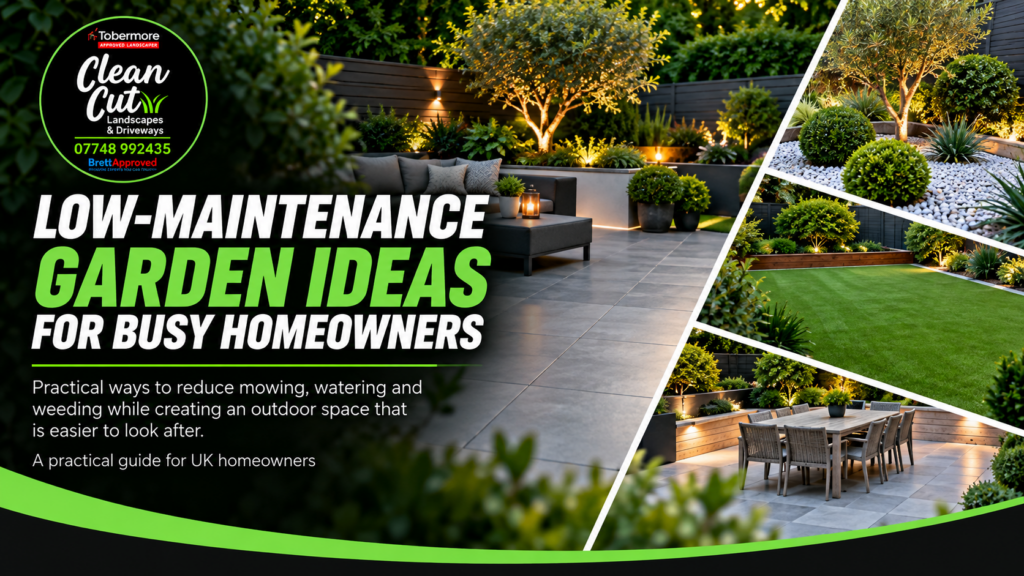
A low-maintenance garden should still feel like a garden. The aim is not to remove every plant or cover the whole space with paving, but to make choices that reduce repetitive jobs such as mowing, watering, weeding and replanting.
For busy homeowners, the right mix of hard landscaping, practical planting and easier-care surfaces can make a noticeable difference. The Royal Horticultural Society also points out that no garden is completely maintenance-free; the goal is to choose lower-input alternatives and design the space around the time you realistically want to spend looking after it.
Here are nine practical ideas that can work individually or as part of a wider garden transformation.
1. Use Hard Landscaping to Reduce High-Maintenance Areas
Patios, paths and other hard-landscaped areas can reduce the amount of lawn and planting that needs weekly attention while creating useful space for seating, dining and entertaining.
Porcelain paving is popular where a clean, contemporary finish and straightforward cleaning are priorities. Natural stone can suit a softer, more traditional look. The aim is not to pave everything, but to use hard landscaping where it improves how the garden functions.
Clean Cut Landscapes & Driveways can incorporate paving into a wider patio and path project, helping the surface work with the rest of the garden.
2. Consider Artificial Grass Where Mowing Is the Main Problem
Artificial grass removes mowing, feeding and reseeding from the maintenance list, which can be useful for households that want a consistently neat lawn-like area without regular grass care.
It is better described as lower-maintenance than maintenance-free. Leaves and debris still need removing, the pile may need occasional brushing and pet areas require cleaning. It is also a plastic product, so convenience should be weighed against environmental considerations and the loss of living habitat that a natural lawn can provide.
If ease of upkeep is the main priority, compare the practical advantages and trade-offs before choosing turf or artificial grass.
3. Create a Gravel Garden with the Right Planting
A gravel garden can create a relaxed, textured look and reduce the amount of lawn or dense border planting that needs regular attention. Gravel itself does not guarantee a weed-free garden, so preparation and occasional spot-weeding still matter.
The best results usually come from combining gravel with plants suited to free-draining conditions. Lavender, many ornamental grasses and other drought-tolerant choices can reduce watering once established, although newly planted specimens still need regular watering while their roots develop.
4. Choose Evergreen Shrubs for Year-Round Structure
Evergreen shrubs can give a garden structure and colour through winter without the need to replant large areas every season. Used along boundaries or as the backbone of a border, they can help the garden look established even when flowering plants have died back.
The key is choosing the right mature size. A supposedly low-maintenance shrub planted in too small a space can quickly become a pruning problem. The RHS describes many evergreen shrubs as relatively easy to care for when they are given the right site and enough room to develop.
5. Use Fewer Plant Varieties in Larger Groups
A border containing dozens of unrelated plants can create a long list of different watering, feeding and pruning requirements. Repeating a smaller palette of reliable plants usually creates a more coherent design and makes maintenance easier to understand.
Ornamental grasses are useful in many schemes because numerous types need relatively little routine care once established. There is no universal 70/30 planting rule that every low-maintenance garden needs to follow; use enough structural planting to give the garden year-round shape, then add seasonal interest in proportions that suit the space.
6. Mulch Beds to Reduce Watering and Weeding
Mulching is one of the simplest ways to reduce routine maintenance in planted areas. A suitable layer over bare soil can help hold moisture, suppress weed growth and protect plant roots.
Organic materials such as composted bark or garden compost can also improve soil as they break down. The RHS recommends a sufficiently thick layer and notes that mulches can reduce both water loss and time spent weeding.
I would be more cautious than Jasper about using plastic weed membrane as a default. It can be useful beneath some decorative aggregate, but woven plastic can deteriorate and leave material in the soil. Appropriate mulch and keeping bare soil covered can often provide a better long-term approach.
7. Make Raised Beds and Containers Work Harder
Raised beds can make gardening easier by reducing bending and giving clearer control over where plants grow. Larger containers can also be useful in smaller gardens because they generally dry out less quickly than tiny pots.
Containers are not automatically low-maintenance, though. Pots need watering more often than plants growing in the ground, particularly during warm weather. If reducing work is the goal, use fewer, larger containers rather than dozens of small pots.
8. Zone the Garden Around How You Actually Use It
One of the most effective low-maintenance strategies is to stop treating the whole garden in the same way. A larger garden might combine a patio near the house, an easier-care lawn area, a small planted border and a more relaxed section further away.
Zoning concentrates the areas that need regular attention where you will notice and enjoy them most. A professional full garden design can bring those elements together while considering movement, seating, boundaries, levels and the amount of maintenance you want to take on.
9. Build in Practical Features That Reduce Future Jobs
Low maintenance is not only about plants. Good access, sensible edging, storage and durable boundaries can all cut down future work. Permanent edging can reduce repeated lawn trimming, while well-planned fencing, decking and retaining walls can make awkward spaces easier to manage.
For gardens where seating and outdoor living are priorities, composite decking can be considered alongside paving and other hard-landscaping options.
How to Choose the Best Low-Maintenance Approach
Start with the jobs you currently dislike most. If mowing dominates your weekends, reduce the lawn or change how it is managed. If watering is the problem, reduce small containers and choose plants better suited to the site. If weeds are the issue, improve planting density and use suitable mulch.
Also think about how much greenery you want to keep. The RHS warns against assuming that paving the entire garden is the only route to lower maintenance. Plants, permeable surfaces and areas of soil can still support drainage, cooling and wildlife while remaining manageable with the right design.
Low-Maintenance Garden Ideas and Sustainability
Lower maintenance and environmental performance are not always the same thing. Artificial grass can save mowing but replaces living ground with plastic. Extensive impermeable paving can reduce gardening work but may increase surface-water runoff and reduce habitat.
A balanced scheme might instead combine a manageable patio with evergreen shrubs, drought-tolerant planting, mulch and a smaller area of lawn or turf. Current RHS guidance for 2026 also points towards climate resilience, water management, wildlife support and planting diversity as important themes in UK gardens.
Frequently Asked Questions
What is the easiest garden to maintain?
There is no single lowest-maintenance design for every property. A practical combination of well-planned hard landscaping, suitable shrubs and perennials, mulched beds and a manageable lawn or lawn alternative will usually require less routine work than a garden full of small borders, annual bedding and awkward lawn edges.
Are gravel gardens low maintenance?
They can be, especially when planted with species suited to dry, free-draining conditions. They still need occasional weeding, tidying and plant care, so they should be thought of as lower-maintenance rather than maintenance-free.
Is artificial grass maintenance-free?
No. It removes mowing and feeding, but debris needs clearing, the surface may need brushing and pet areas require cleaning. It also has environmental trade-offs because it is a synthetic surface rather than living vegetation.
What are the main garden design trends for 2026?
The RHS predicts that climate change, water management, wildlife and plant diversity will be major influences on gardening in 2026. For homeowners seeking easier upkeep, that can mean choosing resilient plants for the right conditions, reducing unnecessary watering and keeping useful greenery within the design.
Create a Garden That Fits Your Lifestyle
A low-maintenance garden is about making deliberate choices. Reduce the jobs you do not enjoy, keep the features you value and invest in materials and planting that suit the conditions rather than fighting them.
With over 15 years of landscaping experience, Clean Cut Landscapes & Driveways can help you combine patios, artificial grass, fencing, decking and planting areas into an outdoor space designed around the way you want to use it. Contact Clean Cut to discuss your garden and request a free quote.
Useful Gardening Guidance
For broader advice on reducing routine jobs without removing all planting, see the RHS guide to low-maintenance gardening.
For advice on reducing watering and choosing plants for drier conditions, see the RHS drought-resistant gardening guidance.
For practical information on suppressing weeds and retaining soil moisture, see the RHS mulching guide.
For current context on changing UK gardening priorities, see the RHS gardening predictions for 2026.