
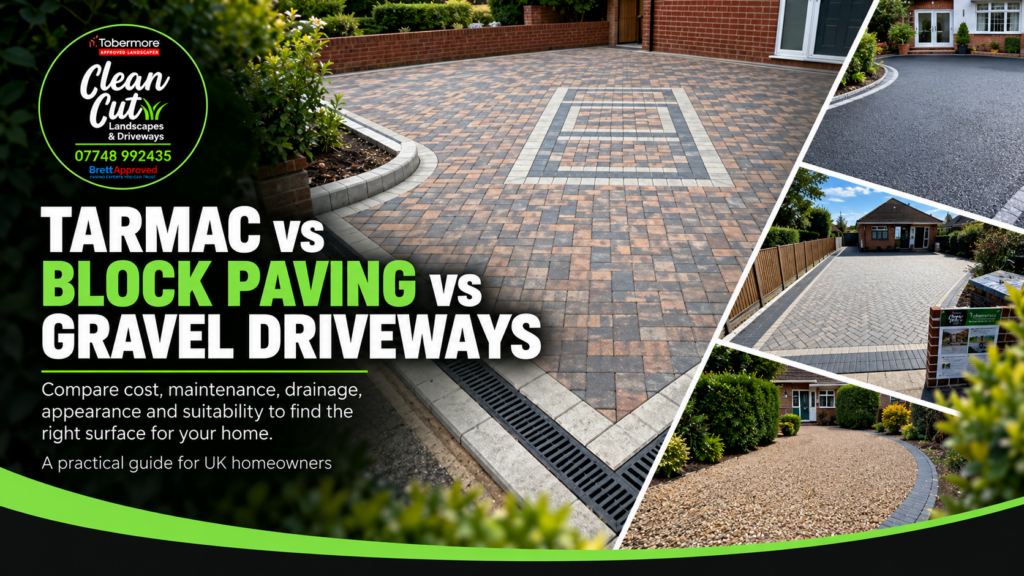
Choosing a new driveway surface is not simply a question of which material looks best. The right option needs to suit the property, expected vehicle use, drainage, maintenance preferences and available budget.
Tarmac, block paving and gravel are all established choices for UK homes, but each has different strengths. Block paving offers design flexibility, tarmac provides a smooth practical finish, while gravel gives a more informal appearance and can form part of a permeable driveway system.
Rather than naming one universal winner, this guide compares the three surfaces so you can choose the option that best fits your home.
Quick Comparison
Choose block paving if appearance, design flexibility and localised repairs matter most. Tarmac is a strong option if you want a clean, continuous surface for regular vehicle use. Gravel suits properties where a loose, more traditional finish works well.
Whatever you choose, the groundwork matters. Excavation, sub-base construction, edge restraints, drainage and finished levels can influence performance just as much as the visible surface.
What Is Block Paving?
Block paving is constructed from individual concrete or clay units laid over a prepared sub-base and bedding layer. It comes in many colours, sizes and laying patterns, making it one of the most adaptable driveway finishes.
If a small area becomes damaged or access is needed beneath the driveway, individual blocks can often be lifted and reinstated rather than replacing the whole surface.
Standard block paving should not automatically be described as permeable. Conventional systems need suitable falls and drainage, while purpose-designed permeable block paving uses wider joints and a free-draining construction to allow water through.
Clean Cut Landscapes & Driveways can incorporate block paving into a wider driveway installation, with the surface, edging and surrounding landscaping considered together.
What Is Tarmac?
The word tarmac is commonly used for black driveway surfacing, although modern domestic driveways are generally constructed using asphalt-type materials rather than the original tar-bound macadam.
Its appeal is simple: it creates a smooth, continuous surface without loose stones or individual joints. That can make it useful where easy vehicle movement and a straightforward appearance are priorities.
Tarmac is normally installed by specialist contractors. Jasper’s draft also suggested every tarmac driveway needs resealing on a fixed three-to-five-year schedule. That is too prescriptive; maintenance depends on the material, age, traffic, installation and condition of the surface.
What Is a Gravel Driveway?
A gravel driveway uses loose aggregate over a stable prepared construction. It can create a softer, more traditional appearance that works particularly well around rural, period and larger properties.
Gravel allows rainfall to move between the stones, but not every gravel driveway automatically performs as an effective drainage system. The sub-base, underlying soil, falls and any drainage provision still matter.
Loose aggregate also needs routine attention. Stones can migrate towards edges, wheel tracks can appear and occasional raking or topping up may be needed. Claims that gravel lasts for a fixed 100 years are therefore not a useful comparison because the surface is replenished over time.
Cost: Compare the Whole Driveway
Generic installed price ranges can be misleading. A quote is affected by the existing surface, excavation, spoil removal, access, sub-base requirements, drainage, edging, size, shape and chosen product.
Gravel is often one of the lower-cost surfacing materials. Decorative block paving can involve more labour, while tarmac can be economical over larger areas. Difficult access or extensive groundwork can change the picture.
Compare quotations on the same scope. One contractor may include excavation, waste removal, drainage channels and edge restraints while another quotes mainly for resurfacing.
Maintenance and Repairs
Block paving normally needs occasional cleaning, weed management and attention to jointing material where it has been lost. Its modular construction makes local repairs relatively straightforward.
Tarmac generally has fewer joints and is simple to sweep, although cracks, edge damage or depressions may need attention as the surface ages. Gravel needs more regular reshaping because loose stones move under traffic.
No driveway surface is genuinely maintenance-free. The best choice is the one whose maintenance pattern suits you.
Appearance and Kerb Appeal
Block paving offers the widest visual choice, with different colours, block formats, borders and patterns available. Tarmac gives a simple, uniform finish and can be combined with contrasting edging. Gravel provides natural variation and often suits traditional properties particularly well.
A driveway can also form part of a wider front-garden scheme. Combining the surface with fencing and boundary features or planting can help the entrance feel more considered.
Drainage and Planning Permission
Specific planning rules apply to paving front gardens in England. Government guidance says planning permission is not normally required for a new or replacement driveway of any size where permeable or porous surfacing is used, such as gravel, permeable concrete block paving or porous asphalt.
An impermeable surface can also remain permitted development if rainwater is directed to a lawn, border or another permeable area within the property. If more than 5 square metres is surfaced with a traditional impermeable material and there is no provision for water to drain to a permeable area, planning permission is normally required.
The government guidance on permeable surfacing of front gardens explains approaches including gravel, permeable paving and directing runoff within the site.
The Planning Portal front-garden guidance also explains the 5 square metre rule and notes that separate approval is required where a dropped kerb is needed for vehicle access across a pavement.
Permeable Block Paving and Porous Asphalt
It is important to distinguish between conventional and permeable versions of the same broad material. Permeable concrete block paving is designed as a complete system, allowing water to pass through the joints into an open-graded sub-base. Porous asphalt is likewise different from a conventional impermeable asphalt surface.
Technical guidance for permeable driveway systems also stresses the importance of edge restraints and correct management of water runoff. Choose the complete construction system rather than assuming the material name alone tells you whether a driveway is permeable.
Which Surface Works Best on a Slope?
Loose gravel can migrate more readily on steeper gradients, particularly where vehicles turn or brake. Tarmac or correctly installed block paving may therefore be easier to manage. Whatever the surface, a sloping driveway needs drainage planning so water does not run towards the house, pavement or neighbouring land.
Which Is Best for Regular Vehicle Use?
For ordinary domestic cars, all three surfaces can work when the driveway is properly constructed. The sub-base needs to suit the ground conditions and expected loading.
For frequent heavy vehicles, do not assume a standard domestic paving product is suitable. Some manufacturers distinguish domestic driveway products from ranges intended for heavier loading.
Where the driveway involves changes in level, retaining walls and blockwork may also form part of the wider landscaping solution.
Which Driveway Should You Choose?
Choose Block Paving If You Want:
- Wide choice of colours, patterns and borders
- Individual units that can be lifted and replaced
- Conventional or purpose-designed permeable systems
- A driveway closely coordinated with the property
Choose Tarmac If You Want:
- A smooth, continuous surface
- A simple, understated appearance
- A surface suited to regular vehicle movement
- A bound finish without loose aggregate
Choose Gravel If You Want:
- A natural or traditional appearance
- A loose surface that allows water between the stones
- A material that can be replenished and regraded
- A practical option where gravel suits the setting
Frequently Asked Questions
Is gravel cheaper than tarmac or block paving?
Gravel is often one of the less expensive surfacing materials, but completed cost still depends on excavation, sub-base work, drainage, edging and access.
Is block paving always permeable?
No. Standard and permeable block paving are different construction systems. A permeable installation needs suitable blocks, jointing material and a free-draining sub-base.
Does tarmac need planning permission?
Not simply because it is tarmac. For a front garden in England, more than 5 square metres of impermeable surfacing normally needs permission unless runoff is directed to a permeable area within the property.
What is the best driveway surface in the UK?
There is no universal best surface. Block paving is strong on design flexibility, tarmac gives a smooth practical finish, and gravel suits homeowners who prefer a natural-looking loose surface.
Plan Your New Driveway
Before choosing the surface, consider how vehicles enter and turn, where rainwater will go, whether the driveway slopes and how the finished surface will meet paths, boundaries and the highway.
With over 15 years of landscaping experience, Clean Cut Landscapes & Driveways can help plan a driveway around your property. For wider projects, it can also be coordinated with garden design and landscaping so the front of the property feels like one complete scheme.
Ready to discuss the options? Contact Clean Cut Landscapes & Driveways