
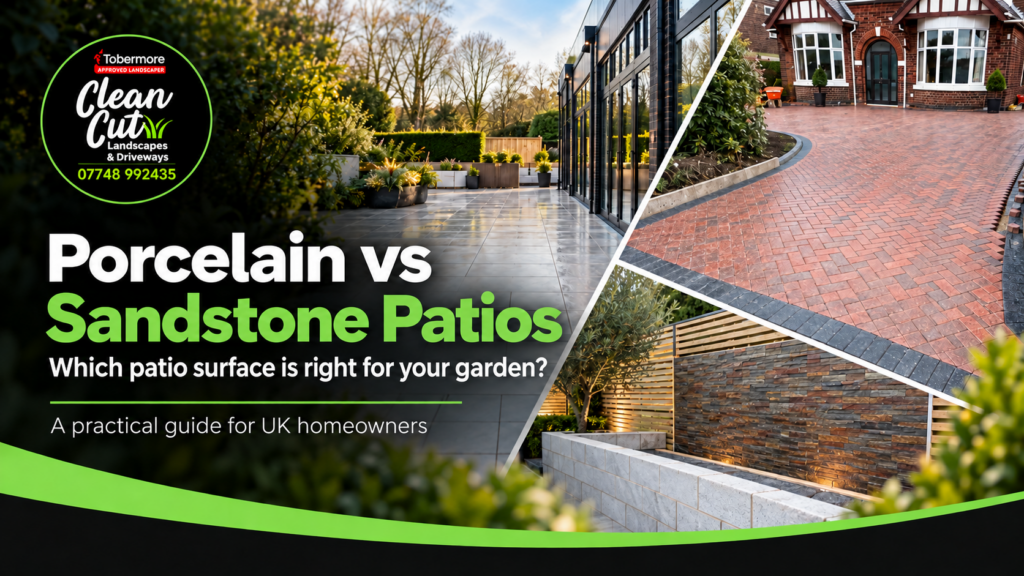
Choosing the right patio material has a big influence on how your finished garden looks, how it feels underfoot and how much maintenance it needs over time. Porcelain paving and Indian sandstone are both popular choices for UK patios, but they create very different results.
Porcelain is manufactured for consistency and low water absorption, while sandstone is a natural material with individual colour and texture from slab to slab. Neither is automatically the better choice for every garden. The right option depends on the style of your property, your budget, the level of maintenance you are comfortable with and the finish you want to achieve.
Quick Verdict: Porcelain or Sandstone?
Choose porcelain if you want a clean, contemporary appearance with consistent sizing, low water absorption and relatively straightforward ongoing cleaning. It works particularly well for modern gardens and homeowners who prefer a more uniform finish.
Choose sandstone if you prefer natural variation, warmer tones and a more traditional or informal character. A well-laid sandstone patio can suit period properties, cottage-style gardens and schemes where natural materials are an important part of the design.
Both can make an excellent patio when the sub-base, falls, mortar bed and jointing are prepared correctly. The decision is therefore less about finding a universal winner and more about matching the material to the garden.
What Is Porcelain Paving?
Outdoor porcelain paving is a manufactured ceramic product fired at high temperatures to create a dense slab. Products sold for external use are designed to cope with outdoor conditions and are available in finishes that imitate stone, concrete and other materials.
One of porcelain’s main advantages is its very low water absorption. Many external porcelain products are manufactured to very low water-absorption specifications, which can help reduce susceptibility to staining and freeze-thaw damage. Always check the technical specification for the exact paving product you are considering.
Porcelain slabs are also manufactured to consistent dimensions, which can create clean lines and relatively uniform joints. Colour variation tends to be more controlled than with natural stone, making porcelain particularly suitable for contemporary garden designs.
What Is Indian Sandstone?
Indian sandstone is a natural stone quarried and cut into paving slabs. Because it is formed naturally, each piece varies in tone, veining and surface texture. That variation is one of its main attractions.
Sandstone has a more porous structure than porcelain. This means it can absorb more moisture and may develop weathering, staining or organic growth depending on its location and exposure. Some homeowners choose to seal sandstone, but sealing is not an automatic requirement for every patio. If a sealer is used, it should be suitable for the particular stone and the desired finish.
Appearance: Consistency vs Natural Character
A contemporary extension with large areas of glazing may suit crisp porcelain paving with straight joints. A traditional brick or stone property may work particularly well with sandstone, where the changes in colour and texture help the patio feel established within the garden.
The paving should also be considered as part of the wider outdoor scheme. Clean Cut can incorporate either material into a larger full garden design, helping the patio work with fencing, lawns, planting areas and other garden features rather than feeling like an isolated surface.
Maintenance and Cleaning
Porcelain generally has the advantage when low maintenance is the priority. Its dense surface does not readily absorb water, so day-to-day dirt is less likely to penetrate the slab. Routine sweeping and appropriate cleaning are usually enough for normal domestic use.
Sandstone needs a little more attention because it is porous and its textured surface can hold dirt and organic growth, particularly in damp or shaded areas. Regular sweeping and suitable stone cleaning can help maintain its appearance.
Jasper’s original draft stated that sandstone must be sealed every two to three years. That is too absolute. Some sandstone patios are left unsealed, while others are sealed to alter water absorption, staining resistance or appearance. If sealing is chosen, follow the stone and sealer manufacturer’s guidance rather than assuming a fixed interval.
Durability and the UK Climate
Both materials can perform well in the UK when suitable paving is selected and installed properly. Porcelain’s low water absorption is a useful advantage in wet and freezing conditions because less moisture enters the body of the slab.
Natural sandstone varies by source and product, so characteristics such as water absorption, strength and frost resistance should not be assumed from the material name alone. Reputable suppliers should be able to provide relevant technical information for the paving being supplied.
Slip Resistance and Safety
Both materials can provide good grip, but the specific finish matters. Outdoor porcelain is commonly supplied with a textured surface, and some products carry an R11 slip classification. That rating should not, however, be treated as a universal characteristic of all porcelain paving.
Sandstone naturally has surface texture, although algae and dirt can make any paving more slippery if it is not maintained. When choosing paving for steps, shaded areas or places that remain wet for long periods, ask for the slip-performance information for the exact product rather than relying on a general material description.
Installation: Which Is More Difficult to Lay?
Both porcelain and sandstone need a properly prepared sub-base and a suitable full mortar bed. The details of installation differ.
Porcelain is dense and generally needs an appropriate bonding or priming slurry on the underside before it is laid. Its consistent thickness makes it possible to achieve very precise lines, but cutting the slabs requires suitable equipment.
Sandstone can vary in thickness, so the installer needs to adjust the bedding layer to maintain a level finished surface and appropriate falls. Whichever material is chosen, the patio should be designed to drain water appropriately and avoid directing runoff towards the house.
For homeowners considering a professionally installed surface, Clean Cut’s patio and paving services cover porcelain, sandstone and wider hard-landscaping projects.
Cost: Look Beyond the Price per Slab
Porcelain is often more expensive to buy than entry-level sandstone, but exact prices vary significantly by product, slab size, finish, supplier and availability. Installation costs can also differ because porcelain may require more specialised cutting and preparation.
For that reason, generic price-per-square-metre figures can become misleading quickly. A useful quotation should consider the complete job, including excavation, waste removal, sub-base preparation, drainage, bedding materials, jointing, cuts, edging and labour.
Sustainability and Responsible Sourcing
There is no simple environmental winner. Porcelain requires energy-intensive manufacturing, while natural sandstone involves quarrying and, when imported from India, significant transport.
Responsible sourcing is particularly important for imported natural stone. The Ethical Trading Initiative’s guidance on sourcing sandstone from Rajasthan explains the labour-rights risks associated with parts of the supply chain and the importance of supplier due diligence. When buying sandstone, ask suppliers where the stone comes from and what responsible-sourcing processes they use.
Can Porcelain and Sandstone Be Used Together?
Changes in level may also require structural landscaping rather than paving alone. Where a project includes terracing or significant level changes, retaining walls and blockwork can be considered as part of the overall design.
Which Patio Material Should You Choose?
Choose Porcelain If You Want:
- A clean, contemporary and consistent finish
- Low water absorption
- Relatively straightforward routine maintenance
- Precise slab dimensions and uniform joints
- A wide choice of stone-effect and modern finishes
Choose Sandstone If You Want:
- Natural colour and variation
- A traditional or rustic appearance
- Each slab to have individual character
- A material that works naturally with planted and informal gardens
- A broad choice of familiar natural-stone colours
Frequently Asked Questions
Are porcelain paving slabs slippery when wet?
They do not have to be. Choose porcelain specifically manufactured for external paving and check the slip-performance information for the product. Textured outdoor finishes can provide good grip, but not every porcelain slab has the same rating.
Does sandstone need sealing?
Not necessarily. Sandstone can be left unsealed, although a suitable sealer may be chosen to change staining resistance, water absorption or appearance. If you decide to seal it, use a product designed for the particular stone and follow the manufacturer’s instructions.
Which lasts longer, porcelain or sandstone?
Both can provide many years of service when the correct product is installed on a properly prepared base. It is better to assess the specification, installation and maintenance than rely on a fixed lifespan claim for either material.
How much extra paving should I order?
An allowance for cuts, breakages and pattern requirements is sensible, but the exact amount depends on the layout and slab format. Your installer or supplier can calculate the appropriate wastage allowance for the project.
Planning Your New Patio
Porcelain is an excellent choice when consistency and lower maintenance are priorities. Sandstone remains a strong option when natural texture and individual character matter more. Before deciding, compare full-size samples outdoors, consider how each surface will look next to your house and discuss the installation requirements as well as the cost of the slabs themselves.
With over 15 years of landscaping experience, Clean Cut Landscapes & Driveways can help you choose and install paving as part of a new patio or wider garden transformation. Contact Clean Cut to discuss your project and request a free quote.